Ghrelin (also called Sermorelin) is a synthetic peptide that mimics the first 29 amino acids of the natural GHRH. The hypothalamus secretes GHRH, instructing the anterior pituitary to release GH (GH). This 29-amino-acid fragment contains the portion responsible for activating GH. It is more stable and easier to handle in laboratory studies compared to the full-length hormone, providing reproducible activity for research purposes. Sermorelin is produced under regulated lab conditions to ensure high purity and reproducibility. It is used in controlled in vitro experiments and in preclinical studies of GH signaling, pituitary function, and metabolism.
Molecular Structure and Composition
Sermorelin is a 29-amino acid peptide resembling the N-terminal part of the natural 44-amino acid GHRH, retaining receptor-binding and activation capability. The peptide ends with an amide group rather than a free carboxylate, increasing stability and protecting against enzymatic degradation in laboratory settings.
- Molecular formula: C₁₄₉H₂₄₆N₄₄O₄₂S
- Molecular weight: ~3358 Daltons
Its small size allows precise handling and reliable analysis in studies of GH regulation.
Mechanism of Action
Sermorelin binds to GHRH receptors on somatotroph cells in the anterior pituitary in laboratory models. This activates adenylate cyclase, raising intracellular cyclic AMP (cAMP) levels. Elevated cAMP enhances endogenous GH production while maintaining normal secretion patterns. Researchers can study the effects of increased natural GH on metabolism, protein synthesis, cell growth, and tissue repair without administering exogenous GH.
Research Applications
Sermorelin is used in laboratory research to examine GH release regulation and downstream effects on biological processes.
GH Secretion Studies
Sermorelin stimulates GH release in cell cultures and isolated pituitary models. Dose-response, timing, and pulsatility are analyzed to reflect normal physiology, providing insight into GH regulation.
Pituitary Function Research
Sermorelin is applied to study pituitary responsiveness under various conditions, including age-related or stress-induced changes, helping to understand GH regulatory mechanisms.
Metabolic and Anti-Aging Research
In laboratory studies, Sermorelin is used to assess metabolism and age-related alterations. It influences protein turnover, lipid and glucose metabolism, and energy balance via endogenous GH and IGF-1 pathways, allowing mapping of GH-related metabolic regulation.
Preclinical Research Applications
Sermorelin is employed in approved animal studies for growth, tissue repair, bone density, and stress or injury recovery. These experiments allow evaluation of elevated endogenous GH without exogenous hormones.
Product Form and Specification
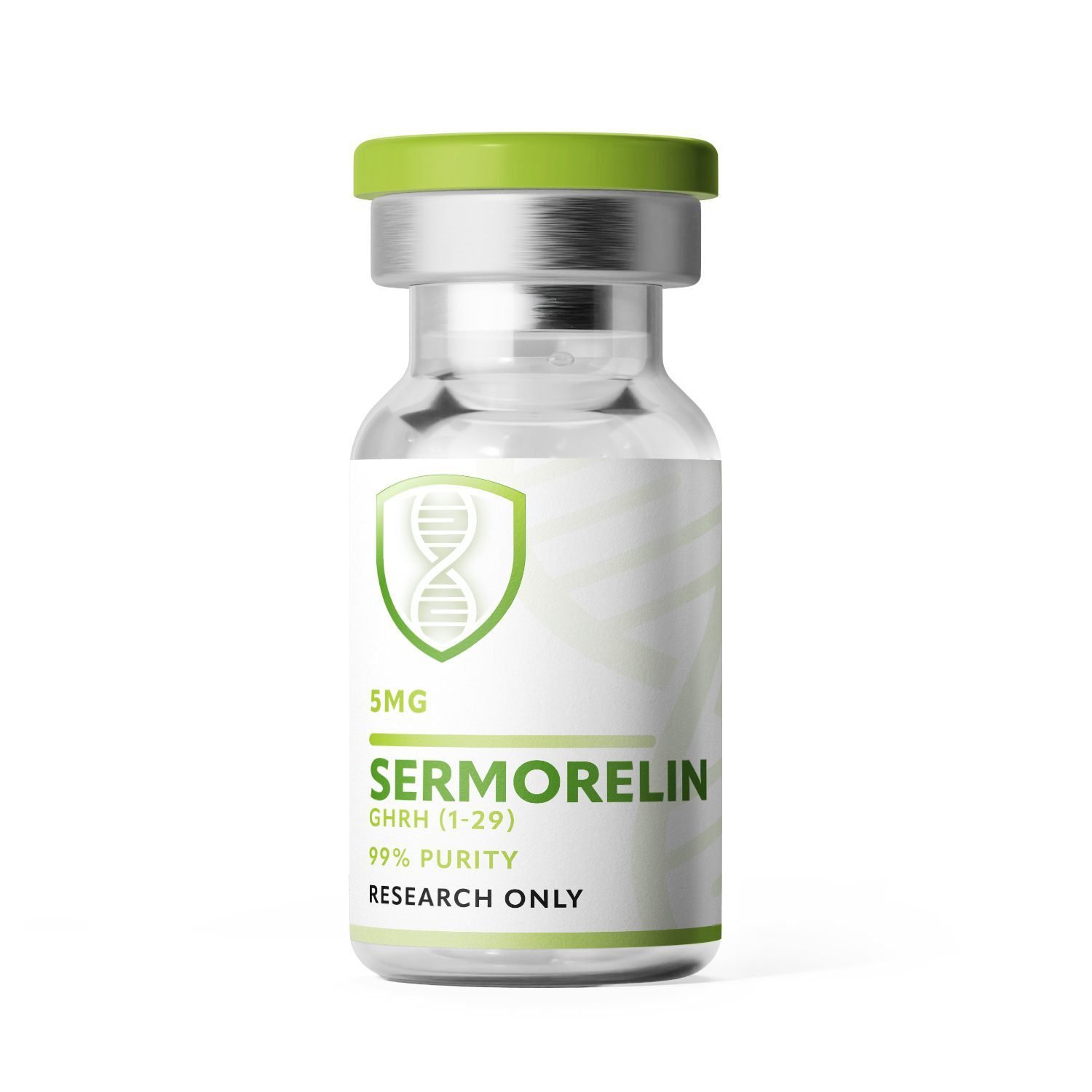
Ghrelin / GH-RH (1-29) is supplied as a sterile glass vial containing 5 mg of white lyophilized powder. Purity exceeds 98% as confirmed by lab testing. No fillers, stabilizers, or preservatives are used, ensuring accurate dosing and reproducibility for laboratory and preclinical research.
Intended Research Use
This product is intended exclusively for laboratory research. It can be used in controlled in vitro studies, including cell culture, and in approved preclinical animal models. Researchers use it to investigate GH signaling, pituitary function, and related metabolic processes. All handling must comply with institutional, ethical, and local regulations.
Storage and Handling
Store lyophilized powder at -20°C in a dry, dark environment. This preserves stability for long-term storage. After opening, minimize air exposure. Reconstitute using sterile or bacteriostatic water, mix gently without shaking, and store the solution at 2–8°C. Use within 14–30 days, depending on the solvent. For longer-term storage, subdivide into aliquots and freeze at -20°C or colder. Avoid repeated freeze-thaw cycles. Maintain aseptic techniques, wear gloves, and work in a clean, controlled environment to prevent contamination.
Regulatory and Safety Disclaimer
Sermorelin / GH 1-29 is supplied strictly for research purposes. It is not approved by the FDA or any other regulatory authority for human or veterinary use, diagnostics, or therapeutic applications. Use is restricted to qualified researchers following legal, institutional, and ethical guidelines. See the material safety data sheet (MSDS), use appropriate protective equipment, and dispose of waste properly. The supplier assumes no responsibility for misuse.
References
- Felix, A., et al. (1996). Human GH-releasing hormone hGHRH(1-29)-NH₂: Systematic structure-activity relationship studies. Peptides, 17(4), 479–486.
- Rafferty, B., Poole, S., Clarke, R., & Schulster, D. (1985). GHRH factor analogue (hGRF1-29NH₂): Immunoreactive-GRF plasma levels after intravenous and subcutaneous administration. Journal of Endocrinology, 107(3), R5–R8.
- Rivier, J., Rivier, C., Galyean, W., Yamamoto, G., & Vale, W. (1988). Potent long-acting GH-releasing factor analogues. Annals of the New York Academy of Sciences, 527, 44–50.
- Esposito, P., et al. (2003). PEGylation of GH-releasing hormone (GRF)(1-29) analogues. Journal of Endocrinology, 176(1), 87–95.
| Sermorelin | 5mg*10vials, 10mg*10vials |
|---|
Be the first to review “Sermorelin/ GHRH”
Related products
All Peptides
All Peptides
All Peptides
All Peptides
All Peptides
All Peptides
All Peptides
All Peptides
Reviews
There are no reviews yet.