What is AOD-9604?
AOD-9604 is a synthetic fragment of the GH C-terminal peptide, comprising residues 177–191 with an additional tyrosine at the N-terminus. It is used in laboratory research to study fat metabolism under controlled conditions. The peptide promotes lipolysis without affecting broader GH effects, such as IGF-1 stimulation. This selective action allows researchers to study lipid degradation and fat-store management without extensive hormonal interference. AOD-9604 is supplied as a stable lyophilized powder suitable for precise experimental use, supporting extended laboratory procedures. Preclinical research focuses on metabolism, cartilage signaling, and obesity models. All studies are restricted to controlled laboratory environments.
AOD-9604 Molecular Formula
AOD-9604 is a 16-amino-acid peptide with a disulfide bridge and the molecular formula C78H123N23O23S2, with a molecular weight of approximately 1815.1 daltons. The cyclic disulfide bond enhances stability in laboratory conditions and ensures consistent results in fat metabolism studies.
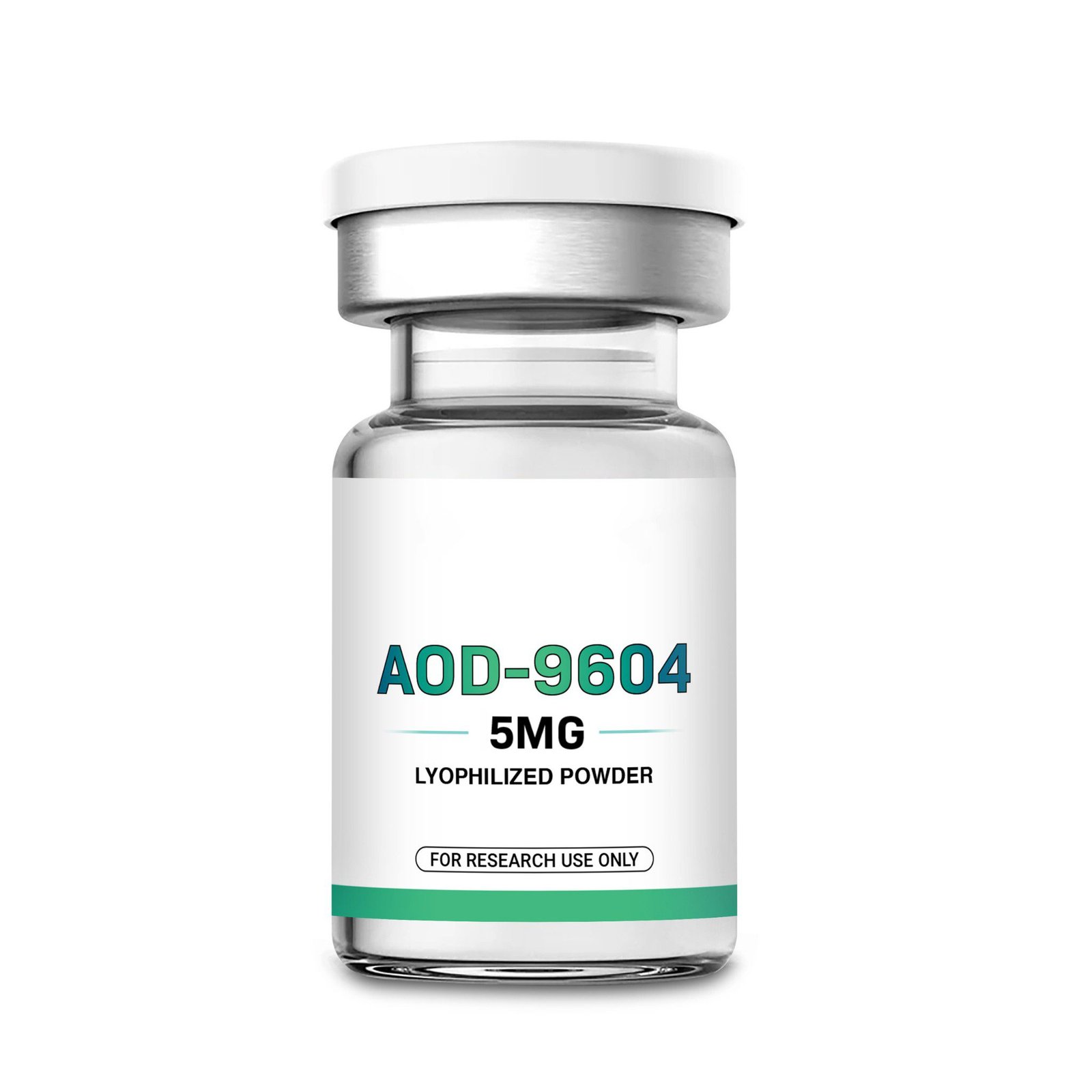
What is AOD-9604 5 MG?
The 5 mg vial contains high-purity lyophilized powder suitable for laboratory research. This amount is ideal for ongoing experiments, repeated testing, or longer studies in cell cultures or animal models of fat metabolism. The larger quantity supports uninterrupted research without frequent reordering. Each sealed, sterile vial can be reconstituted with bacteriostatic water to yield a clear solution suitable for in vitro or preclinical applications.
Structural Profile of AOD-9604
AOD-9604’s sequence is Tyr-Leu-Arg-Ile-Val-Gln-Cys-Arg-Ser-Val-Glu-Gly-Ser-Cys-Gly-Phe. The two cysteine residues form a disulfide bond, creating a cyclic structure that enhances stability. This design mirrors the lipolytic region of GH without broader growth-promoting effects. Its compact structure resists enzymatic degradation, enabling long-duration laboratory studies of fat metabolism.
Laboratory Research on AOD-9604
AOD-9604 is studied in preclinical models to investigate fat-metabolism pathways. In rodent models, it promotes lipolysis by converting stored fat into free fatty acids without stimulating GH pathways, including IGF-1. Cell culture studies demonstrate stimulation of beta-3 adrenergic receptors in adipocytes, enhancing fat oxidation while inhibiting lipogenesis via acetyl CoA carboxylase blockade. Additional research explores cartilage support, maintaining joint matrix and reducing degradation markers in osteoarthritis models.
Peptide Interaction in Laboratory Studies
AOD-9604 interacts with adipose cells to induce fat breakdown without activating full GH receptor pathways. Beta-oxidation and beta-3 adrenergic signaling are selectively stimulated, allowing controlled studies of lipid metabolism and energy regulation.
Production Methodology & Quality Controls
AOD-9604 is synthesized using solid-phase peptide synthesis. Amino acids are sequentially added to resin, followed by cleavage, controlled oxidation to form the disulfide bond, and purification. Each batch is verified with HPLC (>98% purity) and mass spectrometry to confirm molecular identity. Additional tests ensure correct composition and absence of solvents or toxins.
Synthesis & Batch Standards
Batches undergo rigorous quality controls, including HPLC and mass spectrometry, to ensure research-grade consistency. Endotoxins and solvents are tested to guarantee safe, reliable laboratory experiments.
Storing AOD-9604
Store lyophilized AOD-9604 vials at -20°C for long-term stability. Protect from light and moisture using original packaging or opaque containers. Short-term storage at room temperature is acceptable for a few weeks without significant quality loss. After reconstitution with bacteriostatic water or a suitable solvent, store at 2–8°C and use within a limited timeframe. Avoid repeated freeze-thaw cycles to maintain stability and ensure reproducible results.
Intended Research Use & Disclaimer
AOD-9604 is supplied solely for laboratory and scientific research. It is not approved for human or veterinary use, diagnostic procedures, or therapeutic purposes. No claims regarding safety or efficacy in living subjects have been evaluated by the FDA or other regulatory agencies.
Referenced Studies
Only trained personnel should handle this compound. The supplier is not responsible for misuse, improper storage, or use outside controlled research. All sales are final; buyers assume responsibility for compliance and safe laboratory practices.
Research Use Only
This product is intended for laboratory research use only. It is not intended for human or animal consumption, or for use in diagnostic or therapeutic procedures.


Reviews
There are no reviews yet.