
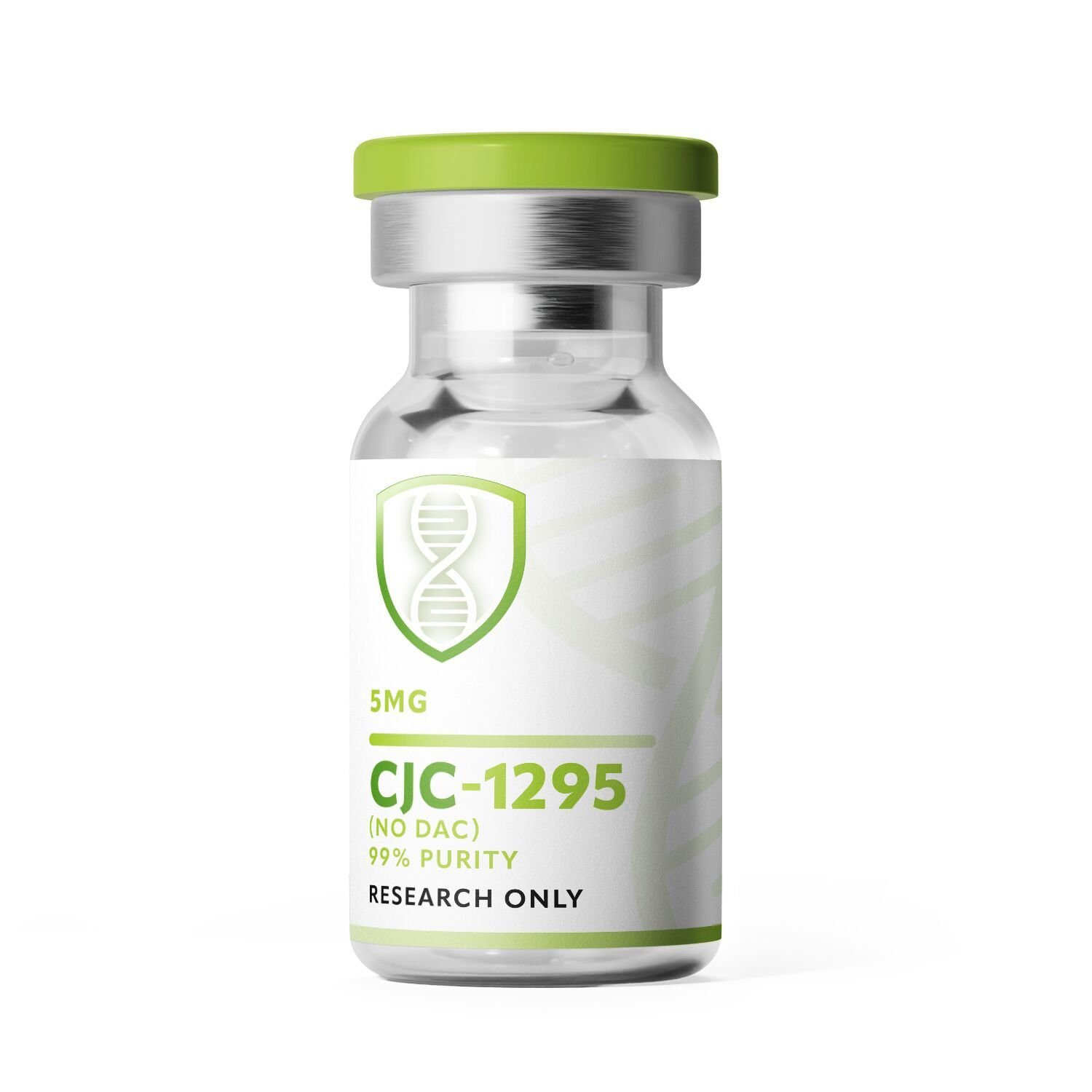
What Is CJC-1295 (No DAC)?
CJC-1295 (no DAC) is also known as Modified GRF 1-29 or Mod GRF (1-29). It is a synthetic peptide analog of the first 29 amino acids of natural GH-releasing hormone. GHRH is also called GRF in research literature. This peptide includes specific amino acid substitutions that improve stability and reduce enzymatic breakdown. These modifications also increase binding to GHRH receptors in laboratory models and help resist DPP-IV cleavage and oxidation. CJC-1295 (no DAC) is supplied as a high-purity lyophilized powder, typically reaching 99% purity or higher through HPLC testing. It is commonly available in 2 mg or 5 mg research vials. Researchers use this compound to study pulsatile GH secretion, pituitary signaling, and IGF‑1 axis activity. The peptide is intended strictly for in vitro and in vivo laboratory research and is not approved for human consumption or therapeutic use.
CJC-1295 (No DAC) Mechanism of Action
In preclinical studies, CJC-1295 (no DAC) acts as a selective GHRH receptor agonist. It binds to receptors located on pituitary somatotroph cells, activating Gs-protein signaling pathways. This interaction increases intracellular cAMP levels and activates protein kinase A, triggering pulsatile release of endogenous GH. The peptide has a short half-life of approximately 30 minutes, producing brief and controlled GH pulses that closely resemble natural hypothalamic and pituitary regulation. Unlike DAC variants, it does not cause prolonged GH elevation. Laboratory studies demonstrate increased GH pulse amplitude and IGF‑1 upregulation without receptor desensitization during short exposure periods.
CJC-1295 (No DAC) Peptide Sequence
CJC-1295 (no DAC) is a linear peptide composed of 29 amino acids with C-terminal amidation for enhanced stability.
Sequence
Tyr-D-Ala-Asp-Ala-Ile-Phe-Thr-Gln-Ser-Tyr-Arg-Lys-Val-Leu-Ala-Gln-Leu-Ser-Ala-Arg-Lys-Leu-Leu-Gln-Asp-Ile-Leu-Ser-Arg-NH₂
Key Substitutions Include
- D-Ala at position 2 to resist DPP-IV cleavage
- Gln at position 8 to reduce deamidation
- Ala at position 15 to improve bioactivity
- Leu at position 27 to prevent oxidation
Further Details
Molecular Formula
C₁₅₂H₂₅₂N₄₄O₄₂
Molecular Weight
Approximately 3367–3368 Da
CAS Number
863288-34-0 These molecular modifications improve peptide stability and support consistent receptor interaction during laboratory experiments.
CJC-1295 (No DAC) 2 mg and 5 mg
CJC-1295 (no DAC) is available in standard research vial sizes. The 2 mg vial is suitable for small-scale experiments such as cell culture assays and early dose testing, allowing precise concentration control after reconstitution. The 5 mg vial supports larger or repeated studies including long-term animal models, GH pulse analysis, and IGF‑1 kinetics research. Larger quantities also improve cost efficiency for extended research work. Both formats are supplied as white lyophilized powder and require reconstitution using sterile or bacteriostatic water under controlled laboratory conditions.
CJC-1295 (No DAC) Research
CJC-1295 (no DAC) is widely used in preclinical research involving cell-based assays and rodent models focused on pulsatile GH secretion. Studies demonstrate dose-dependent increases in GH release along with elevated IGF‑1 levels while maintaining natural GH pulsatility. The peptide supports investigation of endocrine signaling, receptor interaction, and metabolic pathways including lipolysis and protein synthesis. Research models often examine muscle repair mechanisms and adipose tissue metabolism. Compared with DAC variants, the no-DAC form allows improved control of hormone pulse timing, making it valuable for studying natural GH rhythms. The compound remains investigational and lacks regulatory approval for human use.
How to Store and Handle It?
Store unopened vials in a cool, dark, and dry environment. Long-term storage is recommended at −20°C, while sealed vials may remain stable at 2–8°C for several months. Protect the peptide from light exposure and moisture while avoiding temperature fluctuations during storage. After reconstitution, refrigerate the solution at 2–8°C and use within four to six weeks. Avoid repeated freeze‑thaw cycles and always follow sterile laboratory handling procedures using proper PPE.
Disclaimer
CJC-1295 (no DAC) is an investigational research peptide intended solely for in vitro laboratory research and in vivo animal studies. It is not approved by the FDA, EMA, or any regulatory authority for human use, diagnosis, treatment, or supplementation. The compound is classified as a non-approved substance and is prohibited in athletic contexts. Preclinical findings do not predict human outcomes, and no claims are made regarding safety or efficacy in humans. Products should be handled only in qualified research facilities under institutional oversight and are strictly sold for laboratory research use only.
Referenced Citations
- Teichman SL, et al. (2006). Prolonged stimulation of GH and IGF‑1 secretion by CJC‑1295. Journal of Clinical Endocrinology & Metabolism.
- Ionescu M, Frohman LA. (2006). Pulsatile secretion of GH during continuous stimulation by CJC‑1295. Journal of Clinical Endocrinology & Metabolism.
- Alba M, et al. (2006). Administration of CJC‑1295 normalizes growth in GHRH knockout mouse models. American Journal of Physiology – Endocrinology and Metabolism.
- Peptide Sciences & Particle Peptides product data: Sequence and receptor activation details (Mod GRF 1‑29).
| CJC-1295 Whitout DAC | 5mg*10vials, 10mg*10vials |
|---|
Be the first to review “CJC-1295 Whitout DAC”
Related products

All Peptides
All Peptides
All Peptides
All Peptides
All Peptides
All Peptides
All Peptides
5-amino-1mq
Reviews
There are no reviews yet.