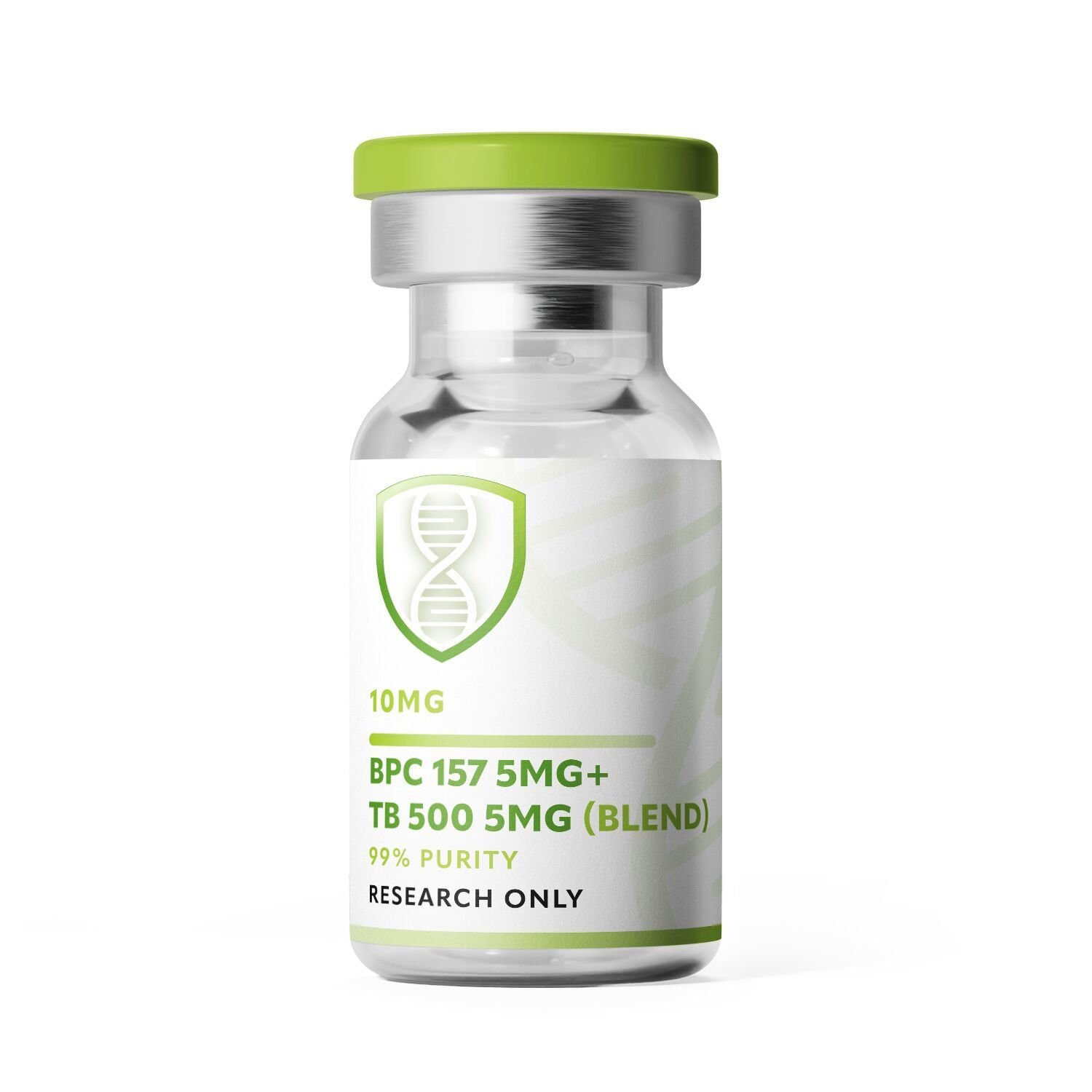
The BPC-157 + TB-500 Blend combines two widely researched synthetic peptides in an equal ratio (1:1, 5mg BPC-157 + 5mg TB-500 per vial). BPC-157 is a stable 15-amino-acid fragment derived from human gastric juice protein, while TB-500 is a synthetic variant of the active domain of Thymosin Beta-4. This combination is studied for synergistic effects on tissue repair, angiogenesis, cell migration, inflammation modulation, and regenerative biology in preclinical models. Each vial is delivered as a clean, lyophilized powder made in the USA with ≥99% purity (HPLC-verified). The pre-mixed format simplifies reconstitution and supports efficient dosing in in vitro assays, cell culture, or animal injury models. This blend is used exclusively for in vitro and in vivo laboratory research and is not for human consumption, therapeutic use, veterinary application, or any non-research purpose. For research use only. Strictly not for human consumption.
Biochemical Characteristics
BPC-157
- Sequence: Gly-Glu-Pro-Pro-Pro-Gly-Lys-Pro-Ala-Asp-Asp-Ala-Gly-Leu-Val
- Molecular formula: C₆₂H₉₈N₁₆O₂₂
- Molecular weight: 1419.55 Da
- Stable in gastric juice; highly resistant to enzymatic degradation
TB-500 (Thymosin Beta-4 fragment)
- Active domain: Ac-LKKTETQ
- Molecular formula: C₃₈H₆₈N₁₀O₁₄
- Molecular weight: ≈889 Da
- Regulates actin polymerization and cytoskeletal dynamics
The blend is provided as a single lyophilized acetate salt powder. The 5mg/5mg ratio allows researchers to explore additive or synergistic effects between gastric-derived cytoprotection and actin-binding repair pathways.
Research Application
In preclinical studies, the BPC-157 + TB-500 combination is used to:
- Accelerate healing of soft musculoskeletal tissues such as ligaments, muscles, and tendons.
- Study fibroblast activity, collagen deposition, and angiogenesis.
- Model reduction of edema and inflammation in ischemia-reperfusion or injury settings.
- Observe formation of granulation tissue, wound closure, and biomechanical healing.
- Compare systemic and localized effects in severe lesions or tendon-to-bone integration models.
- Serve as a tool for peptide-mediated cytoprotection, sports medicine models, and regenerative biology.
The pre-blended vial supports comparative research and continuous dosing without requiring customized reconstitutions.
Mechanism Overview
BPC-157 increases growth factors (VEGF, FGF), FAK-paxillin signaling, and modulates nitric oxide pathways. It promotes angiogenesis, collagen organization, and anti-inflammatory cytokine balance while maintaining endothelial integrity. TB-500 binds actin monomers, sequesters G-actin, and promotes F-actin assembly. It supports angiogenesis, reduces inflammation, and enhances cell migration, differentiation, and cytoskeletal remodeling. Together, BPC-157 and TB-500 improve motility, structural reorganization, growth factor expression, and cytoprotection. Preclinical evidence suggests enhanced fibroblast recruitment, vascularization, and tissue remodeling, improving functional recovery in injury models.
Preclinical Research Summary
BPC-157 promotes tendon, ligament, and muscle healing in rodent models. It counteracts corticosteroid impairment, increases collagen deposition, and strengthens biomechanical properties. TB-500 supports cell migration, angiogenesis, and actin dynamics in wound and soft-tissue repair. Combined use demonstrates improved outcomes in animal research, including:
- Faster formation of granulation tissue and wound closure
- Reduced edema and inflammation
- Enhanced tendon-to-bone integration and ligament tensile strength
- Systemic protection of organs such as liver and kidney in ischemia-reperfusion models
Systematic reviews of over 35 preclinical studies consistently report positive histological and functional results, with no observed toxicity. While promising for musculoskeletal regeneration, human data remain limited.
Form and Analytical Testing
- Form: Sterile, lyophilized powder blend (5mg BPC-157 + 5mg TB-500)
- Purity: ≥99% (HPLC verified)
- Identity: Confirmed by mass spectrometry
- Endotoxin: <0.1 EU/μg
- Solubility: Excellent in bacteriostatic water
- Appearance: White to off-white cake
- Storage (unopened): 2–8°C, protected from light and moisture
- Reconstitution: Use sterile bacteriostatic water under aseptic conditions
- Stability: 24–36 months refrigerated when sealed; reconstituted 4–6 weeks at 2–8°C (avoid repeated freeze-thaw)
All batches undergo third-party analytical testing for purity, identity, and contaminants.
Referenced Citations
- Sikiric P, et al. (2018). Stable gastric pentadecapeptide BPC 157 may recover brain-gut axis and gut-brain axis function. Pharmaceuticals.
- Chang CH, et al. (2014). Pentadecapeptide BPC 157 enhances GH receptor expression in tendon fibroblasts. Molecules. doi:10.3390/molecules191119066
- Vasireddi N, et al. (2025). Emerging Use of BPC-157 in Orthopaedic Sports Medicine: A Systematic Review. HSS Journal. PMC12313605.
- Krivic A, et al. (2006). Achilles detachment in rat and stable gastric pentadecapeptide BPC 157: Promoted tendon-to-bone healing. Journal of Orthopaedic Research. doi:10.1002/jor.20109.
- Malinda KM, et al. (1999). Thymosin β4 accelerates wound healing. Journal of Investigative Dermatology.
RUO Disclaimer
The BPC-157 + TB-500 Blend (5mg/5mg) is an investigational research compound intended solely for in vitro laboratory research and in vivo animal studies. It is not approved by the FDA, EMA, or any regulatory authority for human therapeutic use, diagnosis, treatment, or supplementation. It is classified as a research chemical (WADA S0 non-approved substances category). Preclinical findings do not predict human outcomes; no claims are made regarding safety or efficacy in humans. Products may carry risks, including immunogenicity or impurities if mishandled. It should be handled only in qualified research facilities with institutional biosafety oversight. All sales are for laboratory research use only; not for human or veterinary consumption.
Be the first to review “BPC 157 (5mg) +TB 500 (5mg) Blend 10mg*10vials”
Related products
All Peptides
All Peptides
All Peptides
All Peptides
All Peptides
All Peptides
All Peptides
All Peptides
Reviews
There are no reviews yet.