
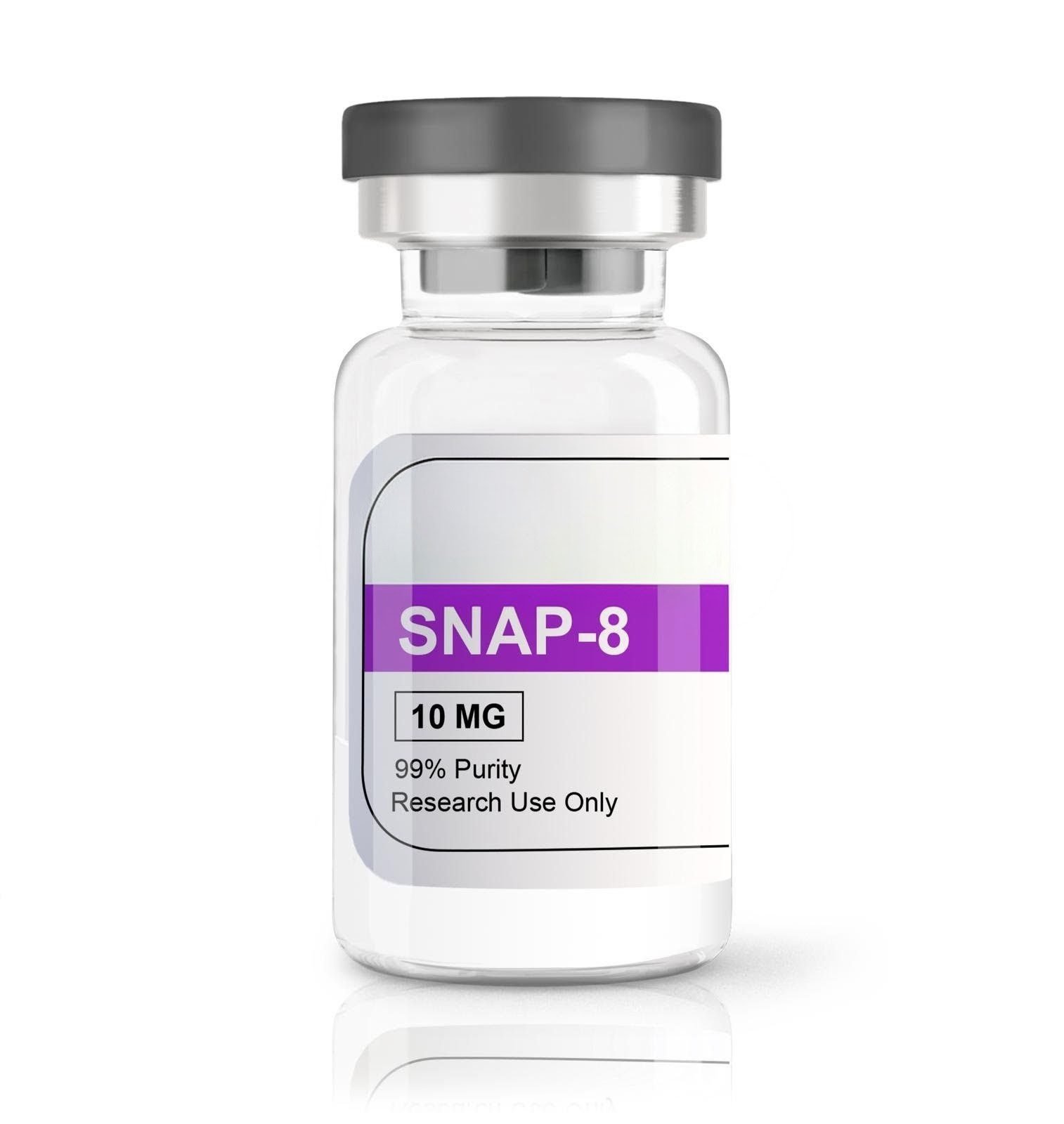
SNAP-8
$42.00
Product Specifications
| Product | SNAP-8 Lyophilized Powder |
|---|---|
| Available Sizes | 10mg |
| Purity | ≥99% (HPLC verified) |
| CAS Number | 868844-74-0 |
| Sequence | Ac-Glu-Glu-Met-Gln-Arg-Arg-Ala-Asp-NH₂ |
| Molecular Formula | C₄₁H₆₅N₉O₁₆ |
| Molecular Weight | 952.01 g/mol |
| Appearance | White lyophilized powder in glass vial |
| Storage | Store lyophilized at -20°C. Reconstituted solution at 2-8°C, use within 21 days. |
| Testing | Third-party tested — Certificate of Analysis available |
| 10mg*10vials |
What is SNAP-8?
SNAP-8 (Acetyl Octapeptide-3) is a synthetic octapeptide designed to modulate the SNARE (Soluble NSF Attachment Protein Receptor) complex, the molecular machinery responsible for synaptic vesicle fusion and neurotransmitter release at the neuromuscular junction. SNAP-8 is based on a fragment of the SNAP-25 protein, one of the three SNARE complex components (along with syntaxin-1 and VAMP-2/synaptobrevin). By mimicking a portion of SNAP-25, SNAP-8 has been investigated for its ability to compete with native SNAP-25 for incorporation into the SNARE complex, potentially reducing the efficiency of synaptic vesicle fusion and neurotransmitter exocytosis. SNAP-8 is an extension of the SNAP-6 (Argireline/Acetyl Hexapeptide-3) concept, with two additional amino acids to improve SNARE complex interaction. It is widely studied in the cosmetic peptide and neuromuscular biology research fields.
Mechanism of Action
SNAP-8 has been investigated for its modulation of SNARE complex assembly at the neuromuscular junction. The SNARE complex is a four-helix bundle formed by SNAP-25 (contributing two helices), syntaxin-1 (one helix), and VAMP-2 (one helix) that provides the mechanical force for synaptic vesicle fusion with the presynaptic membrane and acetylcholine release. Researchers have studied SNAP-8 as a competitive fragment of SNAP-25 that integrates into partially assembled SNARE complexes, reducing the efficiency of full complex formation and vesicle fusion. Studies in neuromuscular biology models suggest that reduced SNARE complex efficiency decreases the quantum of acetylcholine released per nerve impulse, attenuating muscle contraction force. This mechanism is conceptually similar to, but much milder than, botulinum toxin’s proteolytic cleavage of SNAP-25. In cellular exocytosis assays, researchers observed that SNAP-8 treatment was associated with dose-dependent reductions in catecholamine and neurotransmitter release markers.
Published Research
SNARE Complex Biology
Söllner et al. (1993) characterized the SNARE complex and the role of SNAP-25 in synaptic vesicle fusion, providing the molecular biology foundation for SNAP-8’s design [1].
Cosmetic Peptide Activity
Blanes-Mira et al. (2002) characterized the mechanism of SNAP-25-derived peptides in neuromuscular models, demonstrating competitive SNARE complex modulation as the basis for reduced neurotransmitter release [2].
Exocytosis Modulation
Zhang et al. (2009) investigated acetyl octapeptide-3 in chromaffin cell models and observed dose-dependent reductions in catecholamine release, confirming SNARE complex-mediated exocytosis modulation [3].
Be the first to review “SNAP-8”
Related products
All Peptides
All Peptides
All Peptides
All Peptides
All Peptides
All Peptides
All Peptides
5-amino-1mq
Reviews
There are no reviews yet.