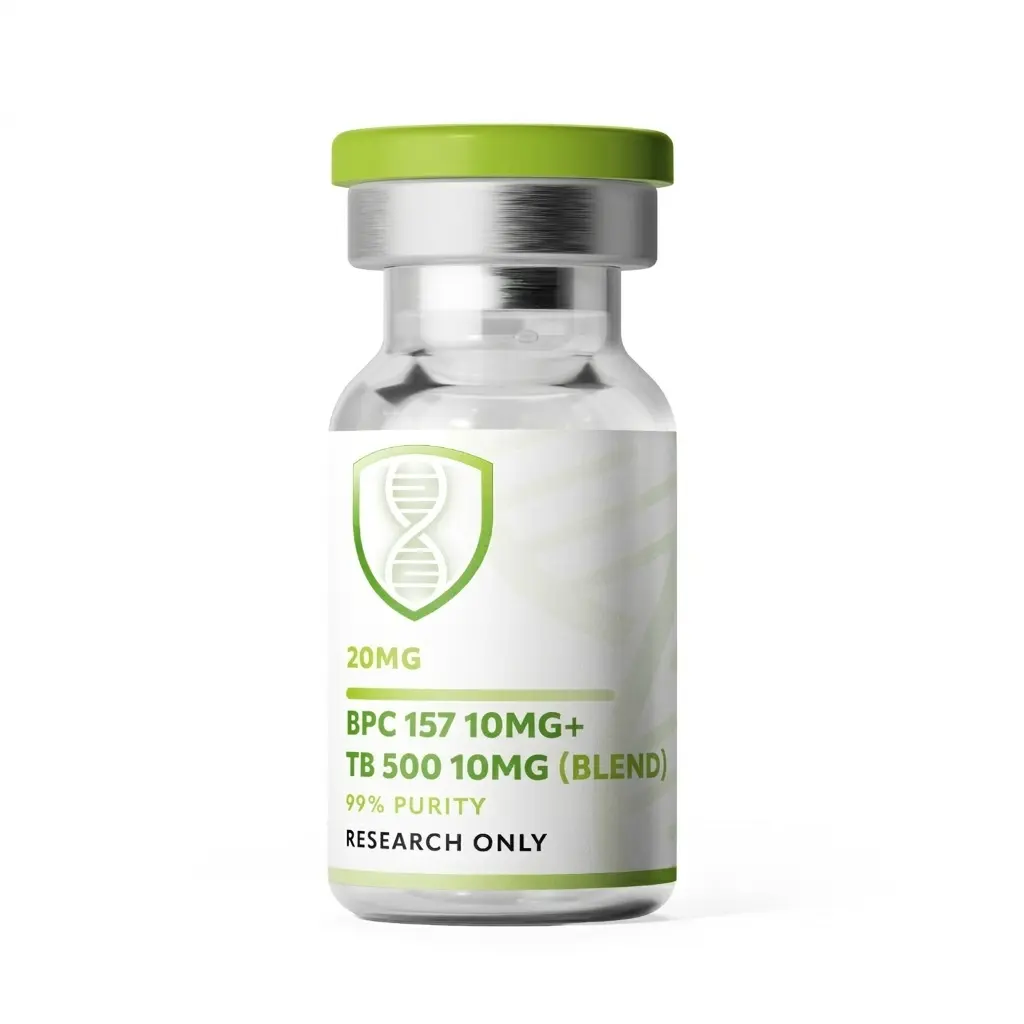
BPC-157 (10mg) + TB-500 (20mg) Blend
The BPC-157 (10mg) and TB-500 (20mg) blend is a widely studied combination in research environments. In this blend, both peptides are commonly combined in a 1:2 ratio, respectively.
What is BPC-157?
BPC-157, also known as Body Protection Compound-157 and PL 1473, is a synthetic peptide made up of 15 Amino Acid. This compound is primarily studied in laboratory settings for its potential effects on injury recovery. However, currently, BPC-157 is not approved by the FDA for human uses due to limited supported studies.
BPC-157 Benefits in Lab Studies
A research study published in Pubmed by the title “ Pentadecapeptide BPC 157 Enhances the GH Receptor Expression in Tendon Fibroblasts” explore the potential role of BPC-157 in healing soft tissue in lab experiments such as:
- Tendons
- Ligaments
- Muscles
- Bones
- Nerves
It is important to know that almost all studies mentioned in that paper were limited to animal models. Researchers observed that BPC-157 may support:
- Faster tissue healing
- Collagen organization
- Blood vessel formation (angiogenesis)
- Reduced inflammation
- Improved recovery in damaged tissues
Disclaimer: BPC-157 is not approved by the FDA for human consumption, and the research studies are mostly limited to animal models. Further research is needed to prove the true potential benefits of BPC-157
Biochemical Characteristics of BPC-157
- Sequence: Gly-Glu-Pro-Pro-Pro-Gly-Lys-Pro-Ala-Asp-Asp-Ala-Gly-Leu-Val
- Molecular formula: C₆₂H₉₈N₁₆O₂₂
- Molecular weight: 1419.55 Da
- Stable in gastric juice; high resistance to enzymatic degradation
What is TB-500?
TB-500 (Ac-LKKTETQ) is a synthetic peptide derived from Thymosin Beta-4. It contains the active fragment made up of amino acids 17–23. TB-500 is mainly studied in labs and research environments to explore its potential role in muscle growth and wound healing. Note:
- TB-500 is not approved by the FDA for human medical use.
- It is still considered a research compound only.
What Researchers Study TB-500 For
In animal and lab studies, TB-500 is mainly explored for:
- Muscle repair
- Wound healing
- Tendon and ligament recovery
- Cell movement (cell migration)
- Tissue regeneration
Biochemical Characteristics
TB-500 (Thymosin Beta-4 fragment)
- Active domain: Ac-LKKTETQ
- Molecular formula: C₃₈H₆₈N₁₀O₁₄
- Molecular weight: ≈889 Da
- Regulates actin polymerization and cytoskeletal dynamics
Preclinical Research Summary of BPC-157 and TB-500
Preclinical research demonstrates that BPC-157 enhances tendon, ligament, and muscle healing, specifically in rodent models. In Achilles transection and ligament injury models, it counteracts corticosteroid impairment, elevates collagen deposition, and increases biomechanical strength. TB-500 supports migration of cells, angiogenesis, and actin dynamics in wound and soft-tissue restoration. In animal research, combined use shows improved results:
- Quicker formation of granulation tissue and wound closure
- Decreased edema and inflammation
- Better tendon-to-bone integration and ligament tensile load
- Systemic effects on the protection of distant organs, such as the liver and kidney in ischemia-reperfusion.
Systematic reviews show that more than 35 preclinical studies regularly produced positive histological and functional results, with no toxicity found in safety evaluations. The mixture is being studied for musculoskeletal regeneration, but the human data is still not enough.
Disclaimer:
The BPC-157 + TB-500 Blend (10mg/10mg) is an investigational research compound intended solely for in vitro laboratory research and in vivo animal studies. It is not approved by the FDA, EMA, or any regulatory authority for human therapeutic use, diagnosis, treatment, or supplementation.
Reference Studies
https://pmc.ncbi.nlm.nih.gov/articles/PMC6271067/ https://en.wikipedia.org/wiki/BPC-157 https://pmc.ncbi.nlm.nih.gov/articles/PMC8275860 https://pubmed.ncbi.nlm.nih.gov/9403790/ https://pubmed.ncbi.nlm.nih.gov/23084823/
Be the first to review “BPC-157 (10 mg) + TB-500 (20 mg) Blend”
Related products
All Peptides
All Peptides
All Peptides
5-amino-1mq
All Peptides
All Peptides
All Peptides
All Peptides
Reviews
There are no reviews yet.