
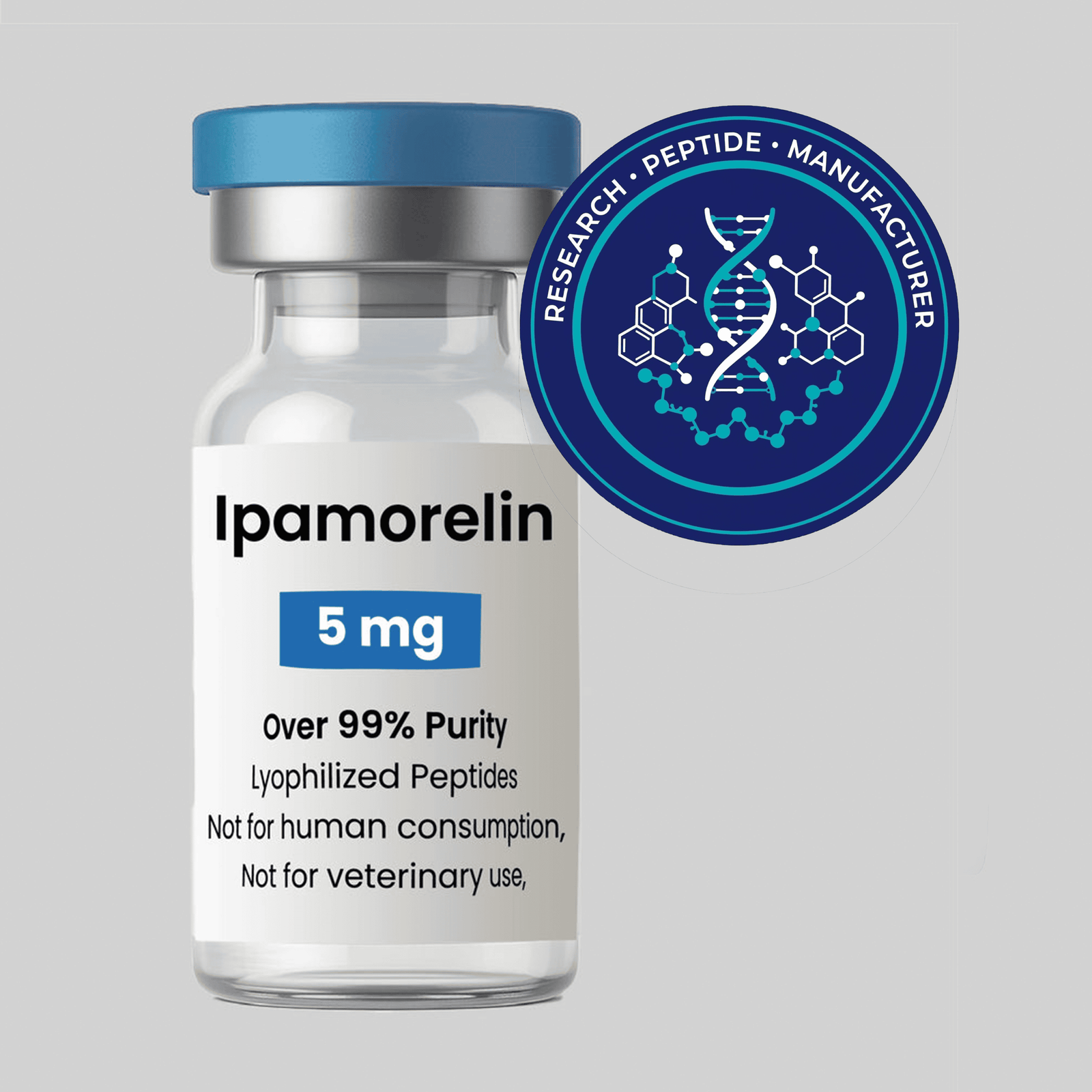
Ipamorelin is a synthetic research peptide used in laboratory and scientific studies. It is manufactured under controlled conditions to ensure high purity and consistent quality across batches.
The peptide is supplied as a lyophilized powder, a stable format suitable for analytical work, molecular research, and controlled experiments. Each vial contains 10 mg of ipamorelin for research use.
Researchers use ipamorelin to study peptide behavior, receptor interactions, and signaling pathways in controlled environments. It is also used to support consistent and reproducible experimental outcomes.
Ipamorelin is intended for research use only. It is not approved for human or animal consumption.
Ipamorelin Molecular Formula
The molecular formula of ipamorelin is C₃₈H₄₉N₉O₈. It is a synthetic pentapeptide composed of both standard and modified amino acids. This structure supports stability and consistency in analytical and molecular research.
This exact structure maintains analytical study, peptide models, and molecular research integrity and reproducibility. Scientists rely on such properties to give consistent results of an experiment in the laboratory.
Ipamorelin Variations You Can Buy At Orion Peptides
Structural Characteristics of Ipamorelin
The sequence of ipamorelin is: Aib-His-D-2-Nal-D-Phe-Lys-NH₂. Its makeup is altered so as to distinguish it from natural peptides. The N-terminus has an Aib (2-aminoisobutyric acid) residue, which increases its resistance to enzyme degradation. Two D-amino acids, D-2-naphthylalanine (D-2-Nal) and D -phenylalanine (D -phenylalanine), enhance stability in laboratory use.
The C-terminus has an amide group rather than a free carboxylic acid, which minimizes rapid degradation. These characteristics make the peptide stable and robust when it is stored or involved in experiments, and enhance the stability of peptides in all analytical and molecular studies.
What is Ipamorelin Research?
The focus of ipamorelin research is the laboratory and preclinical research of the molecular actions and the interaction of the peptide with the receptors. Cell-based assays and in vitro systems are used by scientists to study the binding properties, structural stability, and signaling activity under controlled conditions.
The purpose of these investigations is to assist in assay development, peptide modeling as well as reproducible data between batches. Each of the experiments is in a preclinical laboratory phase, and the peptide is currently used to do scientific research only.
Scientific knowledge and evidence-based findings inform researchers to plan additional research and in-vitro procedures, but do not imply therapeutic or clinical results.
Peptide Interaction in Laboratory Studies
In laboratory studies, Ipamorelin is assayed in regard to its affinity to GH secretagogue receptors (GHS-R1a) in regulated and cellular-based bioassays. Experimental conditions evaluate the reactions of the receptor, binding patterns, and concentration-dependent responses in laboratory models.
It is concerned with the mechanism of peptide selectivity and receptor signaling without insinuating the effects in humans and effects of therapy. Cell lines or preclinical models are used in experiments to provide insights with regard to the molecular interactions, the development of assays, and analytical research. Every batch of Ipamorelin is checked in terms of purity and structural integrity so that the reproducible results of laboratory research are consistent.
Synthesis & Batch Standards
The synthesis of ipamorelin is based on the solid-phase synthesis of peptides in controlled laboratory manufacturing conditions. Amino acids are synthesized stepwise as single amino acids, which are being assembled on a resin support surface; the entire peptide is cleaved and purified.
All batches are carefully tested in terms of quality, and HPLC is used to test purity, and mass spectrometry is used to identify the identity. These controls ensure the peptide is standard, dependable, and suitable for use in research in the laboratory.
Analytical Observations
The high purity of Ipamorelin is confirmed through Batch testing; this was confirmed using high-performance liquid chromatography ( HPLC). The mass spectrometry ensures the molecular weight.
The result is a white, amorphous, lyophilized powder which is freely soluble in sterile water or diluted acetic acid to produce a clear and colorless solution. Other tests that are performed to guarantee structural integrity and minimal contaminants include: additional tests, which are thin-layer chromatography and amino acid analysis.
These are regular analytical processes that guarantee lot-to-lot consistency and promote trustworthy laboratory inquiries.
Ipamorelin Assessment
Laboratory tests are aimed at determining the selectivity, binding characteristics, and reproducibility of the peptide in controlled experimental systems. Dose-response studies, receptor binding studies, and functional analyses are carried out by researchers.
The batch-to-batch testing is used to ensure homogeneity in the activity and structural integrity of all the vials. These tests can effectively be used to study the behavior of peptides, their interaction with receptors, and molecular pathways in preclinical laboratory experiments.
Intended Research Use & Disclaimer
Ipamorelin is only marketed for laboratory and scientific research uses. It is a research-grade peptide and not to be used in human or animal feed, as a drug or diet supplement, or for therapeutic use.
Everything mentioned about Ipamorelin is educational and methodical. All of the local, state, and federal regulations should be adhered to by the researchers who will work with and use this product.
When properly used in laboratory-controlled settings, there will be safe handling and dependable experimental results.
Referenced Studies
| Ipamorelin | 2mg*10vials, 5mg*10vials, 10mg*10vials |
|---|
Be the first to review “Ipamorelin”
Related products
5-amino-1mq
All Peptides
All Peptides
All Peptides
All Peptides
All Peptides
All Peptides
All Peptides
Reviews
There are no reviews yet.